
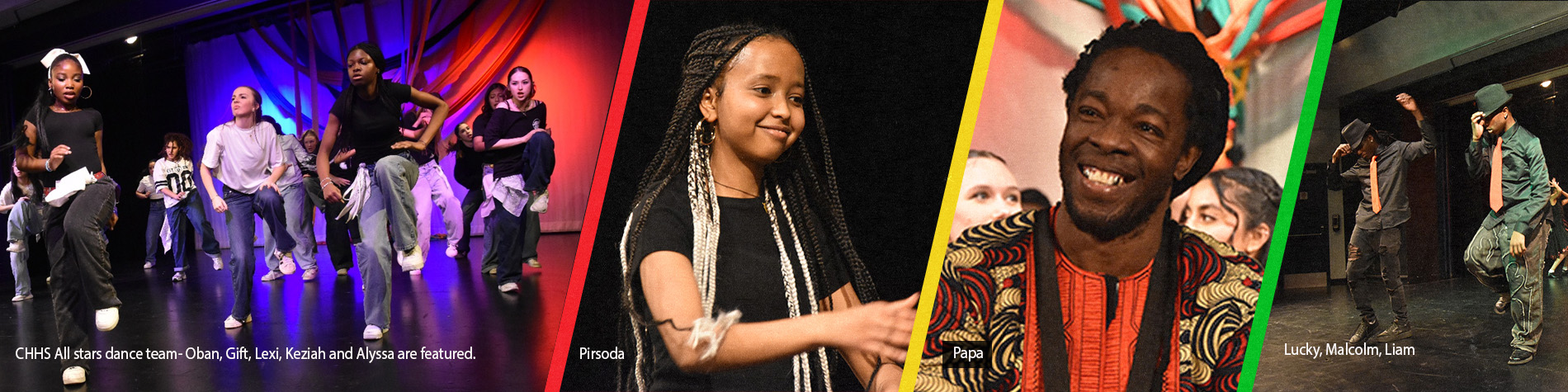
Black History Month began on a high note at Crescent Heights High School as students marked the occasion with a vibrant, student-led production celebrating culture, creativity, and uplifting history that connects us all.
Rooted in Rhythm, a powerful performance, invited the school community to feel the beat and celebrate the legacy of Black excellence through music and movement. Students from Crescent Heights High School brought the stage to life alongside special guest and master drummer Papa from Guinea, whose presence connected students directly to West African traditions.
“I was honoured to be invited into this project because it gave us the opportunity to work alongside Papa from Guinea, an ambassador of art and cultural tradition,” said Masani St Rose, guest choreographer at Crescent Heights High School. “It was remarkable to see how music and movement came together with a deep sense of spiritual connection—an inner knowing that reflects the transfer of knowledge from the knowledge keepers who came before us.”
The event reflects the broader spirit of Black History Month at Crescent Heights High School, serving as a culmination of last year’s celebrations and a foundation for learning that will continue throughout February and beyond. For students Malcolm, Oban, Christ-Gift, and Mehreet, the experience created space for both learning and teaching, while allowing them to express their strengths through movement and collaboration.
As Malcolm shared, “We really put everything out on stage. When you block out outside opinions and allow yourself to be fully expressive, the work becomes more powerful.” This willingness to move through growth also reflected students’ hopes for the audience, not only to learn about the roots and history of jazz and its interconnectedness with West African and African American dance forms, but to leave with a sense of curiosity. Oban captured this sentiment, stating, “It’s not about saying ‘I know,’ but saying ‘I need to keep learning.’ I wanted the audience to leave curious, not feeling like they had all the answers.”
The deep appreciation expressed by students in letters to Papa and Masani highlights how their time, guidance, and generosity played a profound role in shaping new understandings of the cultural origins of dance forms, while fostering community and relational learning through embodied, respectful, and shared experiences.
As Black History Month unfolds, it serves as a reminder to the entire CBE community to honour Black brilliance, amplify voices across generations, and recognize the lasting impact of culture, creativity, and leadership.